Sobha Projects

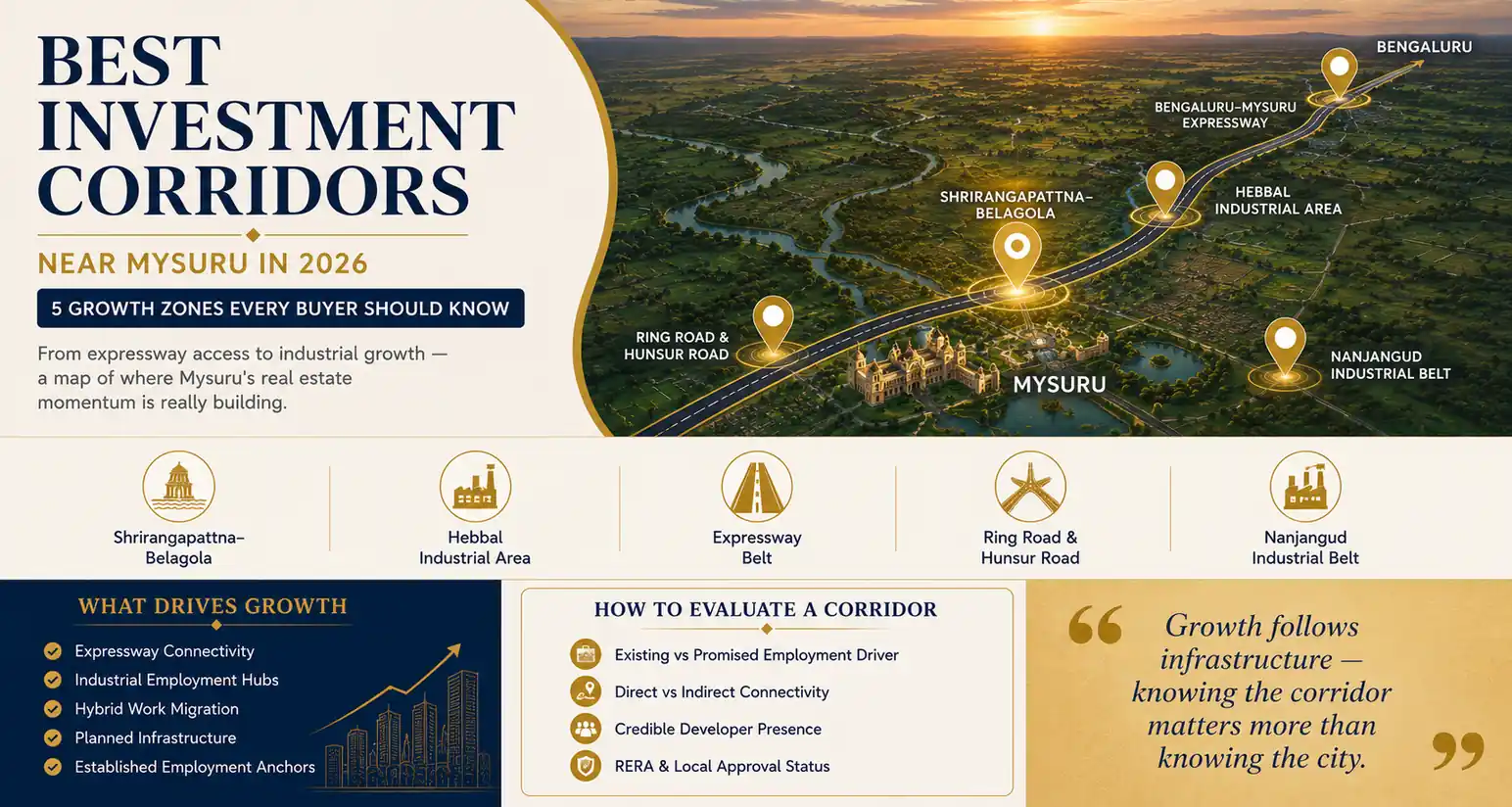
Best Investment Corridors Near Mysuru in 2026

Best Investment Corridors Near Mysuru in 2026

Contents

Introduction

Mysuru has quietly stopped being “the calmer city next to Bengaluru” and started becoming a destination in its own right. Ask anyone who’s been tracking Karnataka real estate over the last few years, and they’ll tell you the same thing: the city’s growth story isn’t happening evenly. It’s concentrated in a handful of corridors — specific stretches of road and land where infrastructure, industry, and connectivity are converging at the same time.

If you’re thinking about buying property near Mysuru in 2026, knowing which corridor you’re buying into matters more than knowing the city’s overall growth numbers. Here’s an honest breakdown of where that growth is actually happening, and what’s driving each one.

Why "Which Corridor" Matters More Than "Which City"

Real estate in any growing city rarely appreciates uniformly. Growth follows infrastructure — a new expressway, an industrial cluster, a tech park, a ring road extension — and land closest to these catalysts tends to move first and move furthest.

Mysuru’s story right now is shaped by three forces working together: the Bengaluru–Mysuru Expressway cutting travel time dramatically, an expanding industrial base on the city’s outskirts, and a steady trickle of professionals choosing a hybrid lifestyle between Bengaluru and Mysuru. Each corridor below benefits from a different combination of these three forces.

1. Shrirangapattna–Belagola Corridor

This stretch, sitting just off the Bengaluru–Mysuru Expressway and along KRS Road, has become one of the more closely watched pockets in the region. It’s historically known for its temples and its position along the Cauvery, but the real estate conversation here has shifted in the last couple of years.

What’s driving it: proximity to Mysuru’s Hebbal Industrial Area, direct expressway access, and enough open land to support large, well-planned layouts rather than piecemeal development. This is also the corridor where SOBHA Boulevard is located — a RERA-approved, MUDA-sanctioned plotted development spread across 9 acres in Belagola village. Projects like this are a reasonable indicator of where established developers see genuine long-term demand, since large, listed developers generally don’t commit land banks to corridors without doing their own due diligence on growth potential first.

For buyers, this corridor suits two kinds of people well: those who want a plot they can build on within a few years, and those comfortable holding land as it appreciates alongside the industrial and residential growth happening around it.

2. Hebbal Industrial Area and Surrounds

Hebbal in Mysuru isn’t to be confused with the Hebbal in Bengaluru — this is an established industrial belt on Mysuru’s own outskirts, and it’s been a quiet employment anchor for the region for years.

What makes this corridor relevant for residential investment isn’t the industrial area itself, but the ripple effect around it — housing demand from the workforce employed there, ancillary businesses, and the general infrastructure upgrades that follow industrial clusters (better roads, more consistent power, expanding civic services).

Land immediately around established industrial zones tends to see steadier, more predictable appreciation than speculative corridors further out, simply because the demand driver (jobs) is already there rather than hoped for.

3. Bengaluru–Mysuru Expressway Belt

The expressway itself has reshaped how people think about the distance between the two cities. What used to be a three-and-a-half to four-hour drive is now a much more manageable stretch, and that single change has altered buying behaviour across the entire corridor.

Professionals working in Bengaluru’s tech parks — particularly those on hybrid schedules — are increasingly looking at towns and villages along this expressway as viable long-term bases, not just weekend-home locations. This is a meaningful shift from even five years ago, when “near Mysuru” mostly meant retirees or holiday-home buyers.

Land directly along or near expressway access points tends to command a premium over land further inside villages, purely on the basis of commute convenience. If you’re evaluating a plot in this belt, proximity to an expressway entry or exit point is worth weighing almost as heavily as the plot’s raw size.
4. Ring Road and Hunsur Road Corridor

Mysuru’s Ring Road and the Hunsur Road stretch (which extends toward Coorg, Hassan, and Mangalore) serve a different kind of buyer  those who want to be closer to the city centre itself rather than further out toward Bengaluru.

This corridor tends to suit end-users more than pure investors: families who want city conveniences  established schools, hospitals, malls  within a shorter daily commute, while still avoiding the densest parts of central Mysuru.

Appreciation here tends to be steadier and less dramatic than the expressway belt, but it also comes with lower risk, since demand is anchored in genuine end-use rather than speculative growth bets.

5. Nanjangud Industrial Belt

Nanjangud, south of Mysuru, has developed a reputation as one of Karnataka’s more established industrial zones outside Bengaluru, hosting a mix of manufacturing and pharmaceutical units over the years.

For residential investment, this corridor works on a longer time horizon. It’s less about immediate lifestyle appeal and more about the slow, compounding effect of sustained industrial employment on surrounding land values. This suits patient investors more than end-users looking for a home to move into soon.

How to Actually Evaluate a Corridor

Regardless of which corridor you’re drawn to, a few questions consistently separate a good decision from a speculative one:

Is there an existing employment driver, or just a promised one? Land near an operating industrial area or established tech park has a different risk profile than land near something still “planned” or “upcoming.”

How direct is the connectivity, really? A corridor that’s technically “near the expressway” but requires a long detour through village roads to actually reach it isn’t the same as one with a direct access point.

Who else is developing here? When credible, listed developers commit to a corridor — not just local layout promoters — it’s usually a signal that due diligence has already been done on the fundamentals: land titles, approvals, and growth trajectory.

Is the specific project RERA registered and locally approved? This matters independent of which corridor you choose. A great corridor with a poorly registered project is still a risky purchase.

Where This Leaves Buyers in 2026

If you’re weighing where to put money into Mysuru real estate this year, the honest answer is that no single corridor is universally “best” — it depends on your timeline, your risk appetite, and whether you’re buying to live or buying to hold.

That said, the Shrirangapattna–Belagola stretch is worth particular attention right now, given the combination of expressway access, proximity to an established industrial base, and the entry of credible, RERA-registered developments into the area. SOBHA Boulevard is a useful example of what a properly planned, fully approved plotted development in this corridor looks like — 126 plots, MUDA sanction, Karnataka RERA registration, and a location that benefits directly from all three growth drivers shaping Mysuru right now.

Whichever corridor you choose, the fundamentals to verify stay the same: real connectivity, a genuine employment or growth driver, and a project that’s fully compliant and transparent about its approvals.

A Quick Checklist Before You Decide

Regardless of which way you lean, verify these before signing anything:

Is the project RERA registered, and does the registration number check out on the Karnataka RERA portal?

Is the layout approved by the relevant local authority (MUDA, BDA, or equivalent)?

What is the developer’s track record on past project delivery?

For plots specifically — is the title clear, and are basic amenities like roads, drainage, and lighting already in place?

Frequently Asked Questions

There's no single "best" corridor — it depends on your goals. The Shrirangapattna–Belagola stretch stands out right now due to its combination of expressway access, proximity to the Hebbal Industrial Area, and the entry of credible, RERA-registered developments. But Ring Road and Hunsur Road suit end-users wanting proximity to the city centre, while Nanjangud suits patient, long-term investors.

Yes, based on current infrastructure trends. It sits directly off the Bengaluru–Mysuru Expressway and KRS Road, and is close to Mysuru's established Hebbal Industrial Area. The presence of large, RERA-approved plotted developments like SOBHA Boulevard in this corridor is also a reasonable indicator that established developers see long-term demand here.

The expressway has significantly reduced travel time between the two cities, making towns and villages along the corridor viable for hybrid workers and long-term residents, not just holiday-home buyers. This has increased demand and land values in areas with direct expressway access.

Land near an established, operating industrial area tends to have steadier and more predictable appreciation, since the demand driver — employment — already exists rather than being speculative. That said, appreciation timelines can be slower and more gradual compared to expressway-facing corridors.

This varies widely based on design complexity, approvals, and budget, but a straightforward independent home typically takes twelve to eighteen months from the start of construction to move-in, assuming approvals are in place.

Both matter, but in a different order. A strong corridor with poor project fundamentals (unclear titles, no RERA registration) is still risky. See the "How to Actually Evaluate a Corridor" section above for the specific checks worth running before you commit to either.

Leave a Comment

Stay Connected with Us

More Related Blogs & Posts
Plot vs Apartment: What’s the Smarter Buy Near Mysuru in 2026?

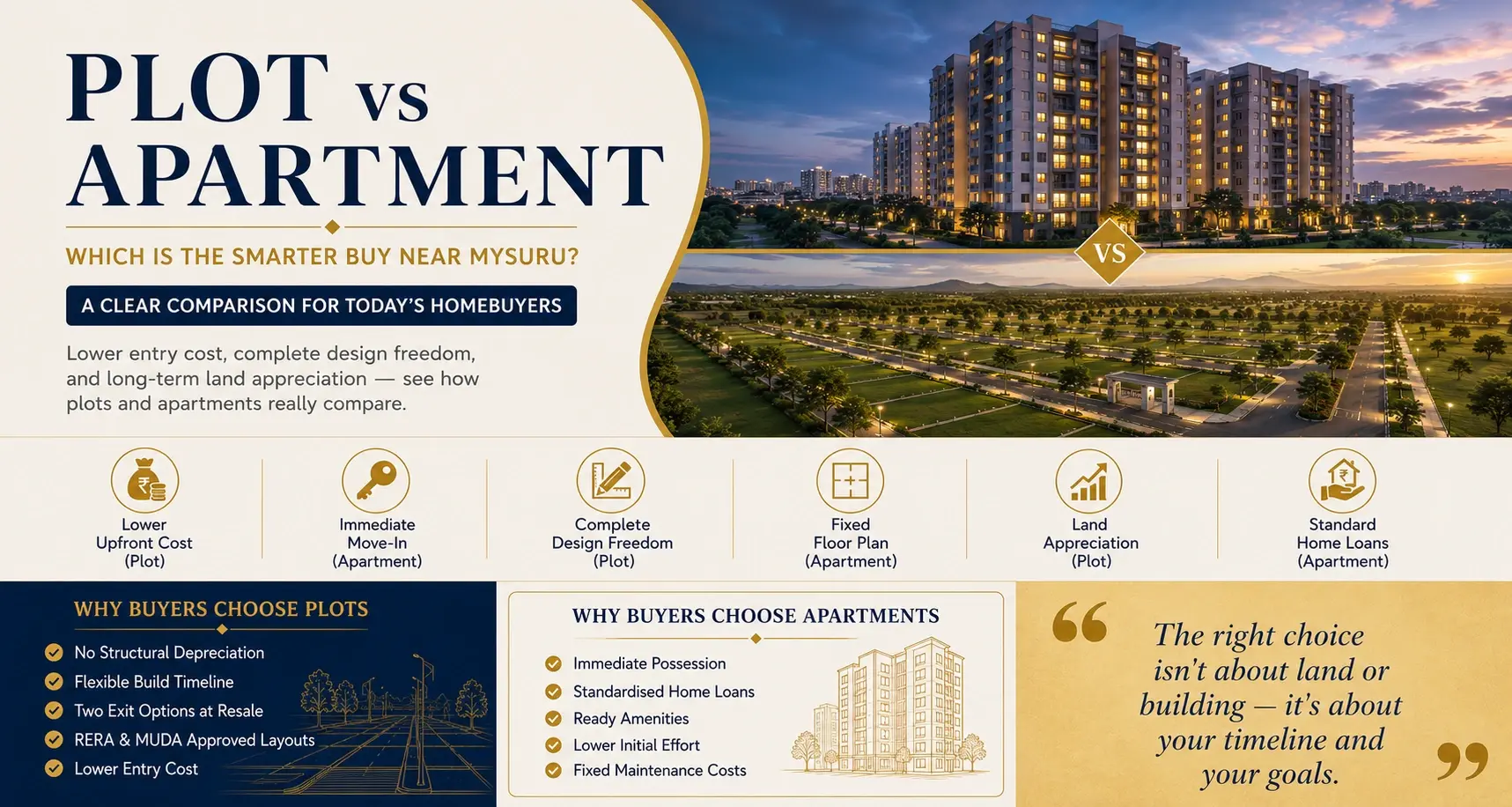
Infographic comparing plot vs apartment investment near Mysuru showing cost, design freedom, and appreciation differences

Plot vs Apartment: What's the Smarter Buy Near Mysuru in 2026?

Contents

Introduction

If you’ve started house-hunting near Mysuru, you’ve probably hit this fork in the road already — do you buy a plot and build later, or go with a ready (or under-construction) apartment?

It’s not a trivial decision. The two options come with different costs, different timelines, and very different long-term outcomes. Here’s an honest, no-fluff comparison to help you figure out which one actually fits your situation.

The Real Difference Isn't Just "Land vs Building"

On the surface, it looks simple: a plot is land, an apartment is a finished home. But the real difference runs deeper it’s about control, timeline, and what you’re actually paying for.

When you buy an apartment, a large part of what you’re paying for is the construction cost, the amenities, and the convenience of moving in almost immediately. When you buy a plot, you’re paying almost entirely for the land itself  and the value of land, unlike a building, doesn’t depreciate with age.

That single distinction is why serious long-term investors and NRI buyers so often gravitate toward plots in growth corridors.

Cost Comparison: What You're Actually Paying For

Apartments typically come at a higher upfront cost per square foot because the price includes construction, finishing, common amenities, and the developer’s margin on the built structure. You’re also usually locked into a maintenance fee for as long as you own it.

Plots are priced almost entirely on land value and location. There’s no depreciating structure baked into the price. As an example, SOBHA Boulevard near Shrirangapattna offers plots starting from ₹79 Lakhs — and what you’re buying is 100% land in a MUDA-approved, RERA-registered layout, with the freedom to construct on your own schedule and budget.

Over a 10-15 year horizon, land in a well-located growth corridor has historically appreciated faster than the resale value of an equivalent apartment, simply because buildings age and land doesn’t.

Timeline: Immediate Move-In vs Build-at-Your-Pace

This is where the two options genuinely serve different needs.

If you need a home in the next 12 months — say you’re relocating for work or your family needs stability quickly — a ready or nearly-ready apartment makes practical sense.

If you have some flexibility and you’re thinking long-term, a plot gives you something an apartment never will: the ability to build exactly what you want, when you want. You can start construction immediately, wait a few years while the land appreciates, or build in phases as your budget allows. That kind of flexibility simply isn’t available once you sign for a flat.

Customisation and Ownership

An apartment gives you four walls someone else designed. You can renovate the interior, but the floor plan, the facade, the number of rooms, the ceiling height — all of it is fixed the day you buy.

A plot puts all of that in your hands. Want a home office with a separate entrance? A larger kitchen? A rooftop terrace? You design it. This is one of the most underrated advantages of plotted developments — the home actually reflects how you live, not a generic floor plan optimised for the maximum number of units per floor.

Infographic comparing plot vs apartment investment near Mysuru showing cost, design freedom, and appreciation differences

Side-by-Side: The Numbers That Actually Matter

Sometimes a table does what three paragraphs can’t. Here’s how the two options stack up on the factors that genuinely influence a buying decision:

Factor

Plot

Apartment

Upfront cost

Lower — you’re paying for land only

Higher — includes construction, finishes, amenities

Move-in timeline

Depends on when you choose to build

Immediate or near-immediate

Customisation

Complete control over design

Fixed floor plan, limited changes

Maintenance cost

None until you build

Ongoing society/maintenance fees

Depreciation risk

Land doesn’t age

Structure ages, value can soften over time

Appreciation potential

Tied to location growth, historically stronger long-term

Tied to location + building condition

Regulatory protection

RERA + local authority approval (MUDA, BDA, etc.)

RERA protection on construction and delivery

Loan availability

Available, but terms differ from home loans

Standard home loan terms, easier processing

Exit flexibility

Can sell as land or after construction

Can only sell as a built unit

None of these rows tell the whole story on their own — but together, they paint a fairly clear picture of why plots and apartments serve fundamentally different buying goals.

The Financing Angle Nobody Talks About Enough

One thing that surprises a lot of first-time plot buyers: financing a plot works differently from financing an apartment.

Banks typically offer a plot loan or land loan rather than a standard home loan, and the terms are often slightly different — loan-to-value ratios tend to be a bit more conservative, and some lenders require proof that you intend to construct within a set period to keep the loan classified favourably. If you’re planning to build immediately, some lenders offer a combined plot-plus-construction loan, which can simplify things considerably. If you’re planning to hold the land purely as an investment, a straightforward plot loan — or paying largely out of pocket — is more common.

Apartment loans, by contrast, are far more standardised. Nearly every major lender offers home loans against ready or under-construction apartments with familiar terms, faster processing, and often higher loan-to-value ratios.

Neither option is difficult to finance. But it’s worth having this conversation with your bank before you commit to either path, because the loan structure can meaningfully affect your overall cash flow.

What Happens When You Want to Sell?

Exit strategy is something buyers rarely think about at the time of purchase — and then think about constantly a decade later.

With an apartment, your resale value is capped by the age and condition of the building, regardless of how good the location is. Buyers factor in the building’s remaining life, the upkeep of common areas, and how dated the amenities feel compared to newer projects nearby.

With a plot, you have two exit paths. You can sell the land as-is, which tends to track the appreciation of the surrounding area fairly closely. Or you can build a home and sell it as a finished property, which usually commands a premium over raw land, assuming the construction quality holds up.

This flexibility is a quiet but significant advantage of land ownership. You’re not locked into a single way of realising your investment.

Long-Term Value: Which Actually Appreciates Better?

This is the question every serious buyer eventually asks, and the honest answer is: it depends on location, but land generally has the edge.

An apartment’s value is tied to the building’s condition, its age, the society’s upkeep, and how well the amenities have aged. A 15-year-old apartment building, even in a good location, often sells at a discount compared to a newer one nearby.

Land doesn’t have that problem. A plot in a location with strong infrastructure fundamentals — highway connectivity, industrial growth, proximity to employment hubs — tends to appreciate independent of any structure sitting on it. This is precisely why the corridor connecting Mysuru to Bengaluru via the expressway has become such a closely watched investment zone. Growth in areas like Shrirangapattna is being driven by the same forces that have historically driven land appreciation in outer Bengaluru over the last two decades — industrial expansion, highway access, and rising employment density.

Risk and Regulatory Protection

Both options come with risk if you’re not careful, but the safeguards look different.

For apartments, RERA protects you against construction delays and misrepresented specifications. For plots, RERA registration protects you against unclear land titles, unapproved layouts, and missing infrastructure commitments — arguably a bigger risk category in the plotted development space, where unregistered or unapproved projects are unfortunately common.

This is why developer credibility matters so much more with land purchases. A RERA-registered, MUDA-approved project from an established developer — the kind of project SOBHA Boulevard represents — removes most of the uncertainty that makes plot buying feel risky to first-timers.

So, Which Should You Choose?

Here’s a simple way to think about it:

Choose an apartment if you need to move in within the next year, you want zero involvement in construction, or you’re prioritising immediate convenience over long-term customisation.

Choose a plot if you’re building for the long term, you want control over your home’s design, you’re comfortable with a build timeline of a few years, or you’re primarily looking at this as an appreciating asset rather than an immediate residence.

For a growing number of buyers near Mysuru — especially those balancing life between Bengaluru and Mysuru thanks to the expressway — plots are increasingly winning out. The combination of lower entry cost, design freedom, and stronger long-term appreciation potential is hard to ignore, provided the project is backed by a credible, RERA-registered developer.

A Quick Checklist Before You Decide

Regardless of which way you lean, verify these before signing anything:

Is the project RERA registered, and does the registration number check out on the Karnataka RERA portal?

Is the layout approved by the relevant local authority (MUDA, BDA, or equivalent)?

What is the developer’s track record on past project delivery?

For plots specifically — is the title clear, and are basic amenities like roads, drainage, and lighting already in place?

Frequently Asked Questions

Generally, a plot has a lower upfront cost since you're paying for land alone, without construction or amenities baked in. The total cost evens out once you factor in building your own home, but you get to control that spend and its timing — something an apartment purchase doesn't allow.

Yes, most banks offer plot or land loans, though the terms differ slightly from standard home loans. If you plan to construct soon after purchase, ask about combined plot-plus-construction loan options, which many lenders offer.

 In well-located growth corridors, land has historically appreciated faster over the long term because it isn't subject to structural depreciation the way buildings are. That said, appreciation always depends on location fundamentals — infrastructure, connectivity, and demand — regardless of whether it's a plot or an apartment.

It can be, if the project isn't RERA-registered or locally approved. That's why verifying RERA registration and authority approval (like MUDA in Karnataka) is non-negotiable before buying land. With a credible, registered developer, the risk profile is comparable to buying an apartment.

This varies widely based on design complexity, approvals, and budget, but a straightforward independent home typically takes twelve to eighteen months from the start of construction to move-in, assuming approvals are in place.

Probably not. Plots suit buyers with some flexibility on timeline. If you need a home within the next year, a ready or near-ready apartment is the more practical choice.

 As per the RERA registration, the proposed completion date is December 31, 2028. The project start date is July 1, 2026.

Final Word

There’s no universally “right” answer between a plot and an apartment — it depends on your timeline, your appetite for involvement in construction, and how you’re weighing convenience against long-term value.

But if long-term ownership, design freedom, and land appreciation are what you’re after, a well-planned, RERA-registered plotted development is hard to beat. SOBHA Boulevard in Shrirangapattna is a good example of what that looks like done right — a credible developer, full regulatory approval, and a location with genuine growth momentum behind it.

Leave a Comment

Stay Connected with Us

More Related Blogs & Posts

Why SOBHA Boulevard in Shrirangapattna Might Be the Plot You’ve Been Waiting For

SOBHA Boulevard – Premium Residential Plots in Shrirangapattna, Mandya near Mysuru

Why SOBHA Boulevard in Shrirangapattna Might Be the Plot You've Been Waiting For

Contents

Introduction

There’s a certain kind of buyer who’s been circling the Mysuru real estate market for a while now — someone who wants land, not just a flat. Someone who wants the freedom to build on their own terms, in their own time. If that sounds like you, SOBHA Boulevard deserves a serious look.

This isn’t a generic “invest now” pitch. It’s a straightforward breakdown of what the project actually offers, where it sits, and why the combination of developer reputation, location, and regulatory transparency makes it stand out among plotted developments near Mysuru right now.

What Is SOBHA Boulevard, Really?

SOBHA Boulevard is a residential plotted development spread across a little over 9 acres in Belagola village, Shrirangapattna, Mandya. It offers 126 plots ranging from 1,200 sq. ft. all the way up to 3,148 sq. ft. (for the larger odd-shaped sites), with pricing starting from ₹79 Lakhs.

The development sits at the edge of Mysuru’s Hebbal Industrial corridor — close enough to the city’s employment hubs and amenities, far enough to feel genuinely open and residential.

SOBHA Limited, the developer, is a publicly listed company with close to three decades of delivery experience across India. The project is RERA-registered under Karnataka’s regulatory authority and has been approved by the Mysuru Urban Development Authority (MUDA). Completion is targeted for December 2028.

That’s the headline. Now let’s get into the detail.

The Case for Buying a Plot Instead of a Flat

A lot of buyers default to apartments simply because they feel more straightforward. You sign, you pay, you get the keys. But that convenience comes at a cost that’s easy to miss upfront.

When you buy a flat, you’re buying a slice of a building on someone else’s land, managed by a committee, governed by bylaws you may or may not agree with, and depreciating in ways that land simply doesn’t.

A plot is different. You own the land outright. You decide what gets built on it, how many floors, what the kitchen looks like, whether there’s a terrace garden. You can build immediately or hold the land while it appreciates. You can develop it in phases. You can pass it on.

In a corridor like Shrirangapattna — which straddles the Bengaluru–Mysuru Expressway and sits adjacent to Mysuru’s expanding industrial belt — land values have strong structural reasons to grow over time. Infrastructure investment in this region has been consistent, and the expressway has brought Bengaluru considerably closer in terms of travel time.

If you’ve been on the fence about plots versus flats, the combination of location fundamentals and developer credibility at SOBHA Boulevard is worth sitting with.

Understanding the Plot Sizes

One of the more practical things to appreciate about this project is the range of configurations on offer:

Type 1 — 40 × 60 ft (2,400 sq. ft.) — 13 plots These are the larger plots. If you’re planning a spacious multi-generational home or simply want more breathing room between you and your neighbour, this is the configuration to target. There are only 13 of them, so availability is limited.

Type 2 — 30 × 50 ft (1,500 sq. ft.) — 42 plots The most popular size in the project, and with good reason. 1,500 sq. ft. gives you enough room to build a comfortable three-bedroom home with a small garden, without the plot feeling overwhelming to maintain.

Type 3 — 30 × 40 ft (1,200 sq. ft.) — 46 plots Compact by plotted development standards, but not small. A 1,200 sq. ft. plot can support a well-designed two or three-bedroom house. For a first-time land buyer or someone building a straightforward family home, this is a sensible entry point.

Odd Sites — Varies (1,306 to 3,148 sq. ft.) — 25 plots These are the wildcard configurations, and they’re genuinely interesting. Their irregular dimensions often mean more flexibility in building design — and in some cases, a larger total area than the standard configurations. If you’re an architect or someone who enjoys working with space creatively, these are worth exploring.

Location: What "Near Mysuru" Actually Means Here

The phrase “near Mysuru” gets used loosely in real estate. Let’s be specific about what SOBHA Boulevard’s location actually delivers.

The project is in Belagola village, Shrirangapattna — a locality that sits along the KRS Road (Mysuru Bypass) and has access to the Bengaluru–Mysuru Expressway. This means getting to central Mysuru is a straightforward drive, and reaching Bengaluru via the expressway is significantly more manageable than it was even five years ago.

For working professionals, the proximity to tech parks matters. Renaissance Firstface Tech Park, Infosys, Varsha Tech Park, and Nesara Tech Park are all accessible from the project area. As more professionals adopt hybrid work arrangements — splitting time between Bengaluru and a base closer to Mysuru — locations like this become genuinely attractive.

For families, the school landscape is solid. NPS International School, De Paul International Residential School, and Podar International School are all within the wider Mysuru region.

For healthcare, the options nearby include Manipal Hospital Mysuru, Apollo BGS Hospitals, JSS Hospital, and the Sri Jayadeva Institute of Cardiovascular Sciences and Research — which is particularly relevant for anyone with an older family member they’re building a home near.

For everyday life, retail and leisure options like BB Habitat Mall, Forum Mall, Nexus City Centre, and Mall of Mysore round out the picture. These aren’t aspirational amenities — they’re functioning parts of the local infrastructure.

The connectivity story is also sensible: Ring Road access, Hunsur Road (which links to Coorg, Hassan, and Mangalore), and the expressway together mean that residents aren’t boxed into a single route in or out of the locality.

Sobha Boulevard premium plotted development in Shrirangapattna near Mysuru with RERA approved residential plots

The Master Plan: What the Layout Tells You

A lot of buyers look at the master plan as an afterthought — something you glance at after the price and the location have already sold you. That’s a mistake.

The master plan of SOBHA Boulevard tells you something important: this is a thoughtfully laid out development, not a land parcelling exercise. Wide internal roads run through all plot clusters, green open spaces are distributed across the layout, and there’s a dedicated civic amenities area integrated into the plan.

When you’re evaluating a specific plot within the layout, there are three things worth checking on the master plan:

How close is your plot to the green zones? A plot adjacent to open green space gives you natural light, air, and a buffer from your immediate neighbours. That translates into better quality of life once you’re actually living there.

What’s your plot’s relationship to the internal roads? Every plot in SOBHA Boulevard has direct road access — there are no awkward plot clusters cut off from the road network. But the width of the road your plot fronts can still make a difference to how your driveway and entry work.

How far are you from the main entry? This is a personal preference question. Some buyers want to be close to the main gate for convenience. Others prefer to be deeper inside the community for peace and quiet.

Pricing: Starting at ₹79 Lakhs

For a SOBHA-developed, RERA-registered, MUDA-approved plot in the Mysuru growth corridor, the starting price of ₹79 Lakhs is a meaningful entry point.

The final price you pay will depend on the specific plot number, configuration, and current availability — and it will be subject to applicable taxes, registration charges, and other statutory costs. For exact plot-level pricing, speaking directly with the SOBHA sales team is the right move.

What’s worth noting is that this project sits at a stage where early buyers typically have more choice — in terms of which specific plot they get, and potentially in terms of negotiating on any available offers.

RERA Registration: Why This Matters More Than You Might Think

RERA registration isn’t just a box to tick. It’s a statutory commitment.

When a developer registers a project under Karnataka’s Real Estate Regulatory Authority, they’re making enforceable promises about timelines, land title, approvals, and the use of funds collected from buyers. Any deviation from those commitments gives buyers legal recourse.

SOBHA Boulevard’s registration details are as follows:

Registration No: PRM/KA/RERA/1267/374/PR/100626/008716
Approved On: June 10, 2026
Project Start Date: July 1, 2026
Proposed Completion: December 31, 2028
Approving Authority: MUDA (Mysuru Urban Development Authority)

You can verify every detail independently on the Karnataka RERA portal using the registration number above. That transparency is one of the more underrated aspects of buying in a RERA-registered development.

About SOBHA Limited: A Name That Actually Carries Weight

There are many developers who put premium branding on projects that don’t quite match the promise. SOBHA is not in that category — and that’s not a marketing line, it’s a verifiable track record.

SOBHA Limited has been building residential and commercial properties since 1995. What distinguishes them from most developers is their backward integration model: they control most of their construction process in-house, which means quality checks happen at every stage rather than being delegated to subcontractors.

The company holds ISO 9001:2015 certification, is an IMS-certified organisation, and is a member of CREDAI. Their NRI buyer base — one of the most discerning buyer segments in Indian real estate — is a meaningful indicator of the trust the brand commands.

For a plotted development, where the developer’s role is primarily in layout planning, approvals, and infrastructure development rather than construction, what matters most is whether they deliver on their commitments. SOBHA’s track record on that front is well documented.

Who Is This Project Actually Right For?

Not every project is right for every buyer. Here’s a honest read of who SOBHA Boulevard suits best:

Professionals working in Bengaluru or Mysuru who want to own land in a quality development without moving far from the city. The expressway connectivity makes this viable as a primary residence for hybrid workers.

Families planning a long-term home who want to build something designed around their actual needs, not adapt to a floor plan someone else decided. A plot gives you that latitude.

Investors looking for land appreciation in a corridor that has strong infrastructure fundamentals. The Bengaluru–Mysuru expressway, Hebbal Industrial Area, and the growing presence of tech parks in the region create a solid medium-to-long-term case.

First-time land buyers who want the backing of a credible developer and the protection of RERA registration — without jumping straight into a large land purchase in an unregulated or underdeveloped area.

Final Thought

Buying land is a longer-term decision than buying a flat. It requires patience — both in the search and after the purchase. But when the location is right, the developer is credible, and the regulatory protections are in place, it’s one of the most enduring things you can own.

SOBHA Boulevard ticks those boxes in a region that has genuine growth momentum behind it.

If you’ve been looking for the right plot near Mysuru, this one is worth a site visit and a detailed conversation with the team.

Explore SOBHA Boulevard

Frequently Asked Questions

The project is in Belagola village, Shrirangapattna, Mandya — PIN 571606. It sits close to Mysuru's Hebbal Industrial Area and is accessible via the Bengaluru–Mysuru Expressway and KRS Road. It's a practical distance from central Mysuru without being in the middle of city density.

Plots start from ₹79 Lakhs. The final price depends on the plot size, type, and its specific position within the layout. You'll also need to factor in registration charges, applicable taxes, and other statutory costs on top of the base price. For a plot-specific quote, reach out to the SOBHA sales team directly.

There are 126 plots in total. Sizes range from 1,200 sq. ft. (30×40 ft) to 2,400 sq. ft. (40×60 ft), with 25 odd-shaped plots going up to 3,148 sq. ft. The most common configuration is the 30×50 ft plot (1,500 sq. ft.), with 42 units available in that size.

 Yes. The project is fully registered under Karnataka RERA with registration number PRM/KA/RERA/1267/374/PR/100626/008716, approved on June 10, 2026. You can verify this independently on the Karnataka RERA portal.

The project has been approved by the Mysuru Urban Development Authority (MUDA). This is the relevant local planning authority for this area, and MUDA approval means the layout and land use have been formally sanctioned.

 As per the RERA registration, the proposed completion date is December 31, 2028. The project start date is July 1, 2026.

Leave a Comment

Stay Connected with Us

More Related Blogs & Posts

Enter Your Details to Request Complete Information

Exclusive Offers | Download Brochure | Schedule Site Visit