
Waterfront Apartments in Kochi
Waterfront Apartments in Kochi: Why Marina One Stands Out More Details Contents Ask anyone who’s house-hunted in Kochi over the
Mysuru has quietly stopped being “the calmer city next to Bengaluru” and started becoming a destination in its own right. Ask anyone who’s been tracking Karnataka real estate over the last few years, and they’ll tell you the same thing: the city’s growth story isn’t happening evenly. It’s concentrated in a handful of corridors — specific stretches of road and land where infrastructure, industry, and connectivity are converging at the same time.
If you’re thinking about buying property near Mysuru in 2026, knowing which corridor you’re buying into matters more than knowing the city’s overall growth numbers. Here’s an honest breakdown of where that growth is actually happening, and what’s driving each one.
Real estate in any growing city rarely appreciates uniformly. Growth follows infrastructure — a new expressway, an industrial cluster, a tech park, a ring road extension — and land closest to these catalysts tends to move first and move furthest.
Mysuru’s story right now is shaped by three forces working together: the Bengaluru–Mysuru Expressway cutting travel time dramatically, an expanding industrial base on the city’s outskirts, and a steady trickle of professionals choosing a hybrid lifestyle between Bengaluru and Mysuru. Each corridor below benefits from a different combination of these three forces.
This stretch, sitting just off the Bengaluru–Mysuru Expressway and along KRS Road, has become one of the more closely watched pockets in the region. It’s historically known for its temples and its position along the Cauvery, but the real estate conversation here has shifted in the last couple of years.
What’s driving it: proximity to Mysuru’s Hebbal Industrial Area, direct expressway access, and enough open land to support large, well-planned layouts rather than piecemeal development. This is also the corridor where SOBHA Boulevard is located — a RERA-approved, MUDA-sanctioned plotted development spread across 9 acres in Belagola village. Projects like this are a reasonable indicator of where established developers see genuine long-term demand, since large, listed developers generally don’t commit land banks to corridors without doing their own due diligence on growth potential first.
For buyers, this corridor suits two kinds of people well: those who want a plot they can build on within a few years, and those comfortable holding land as it appreciates alongside the industrial and residential growth happening around it.
Hebbal in Mysuru isn’t to be confused with the Hebbal in Bengaluru — this is an established industrial belt on Mysuru’s own outskirts, and it’s been a quiet employment anchor for the region for years.
What makes this corridor relevant for residential investment isn’t the industrial area itself, but the ripple effect around it — housing demand from the workforce employed there, ancillary businesses, and the general infrastructure upgrades that follow industrial clusters (better roads, more consistent power, expanding civic services).
Land immediately around established industrial zones tends to see steadier, more predictable appreciation than speculative corridors further out, simply because the demand driver (jobs) is already there rather than hoped for.
The expressway itself has reshaped how people think about the distance between the two cities. What used to be a three-and-a-half to four-hour drive is now a much more manageable stretch, and that single change has altered buying behaviour across the entire corridor.
Professionals working in Bengaluru’s tech parks — particularly those on hybrid schedules — are increasingly looking at towns and villages along this expressway as viable long-term bases, not just weekend-home locations. This is a meaningful shift from even five years ago, when “near Mysuru” mostly meant retirees or holiday-home buyers.
Land directly along or near expressway access points tends to command a premium over land further inside villages, purely on the basis of commute convenience. If you’re evaluating a plot in this belt, proximity to an expressway entry or exit point is worth weighing almost as heavily as the plot’s raw size.
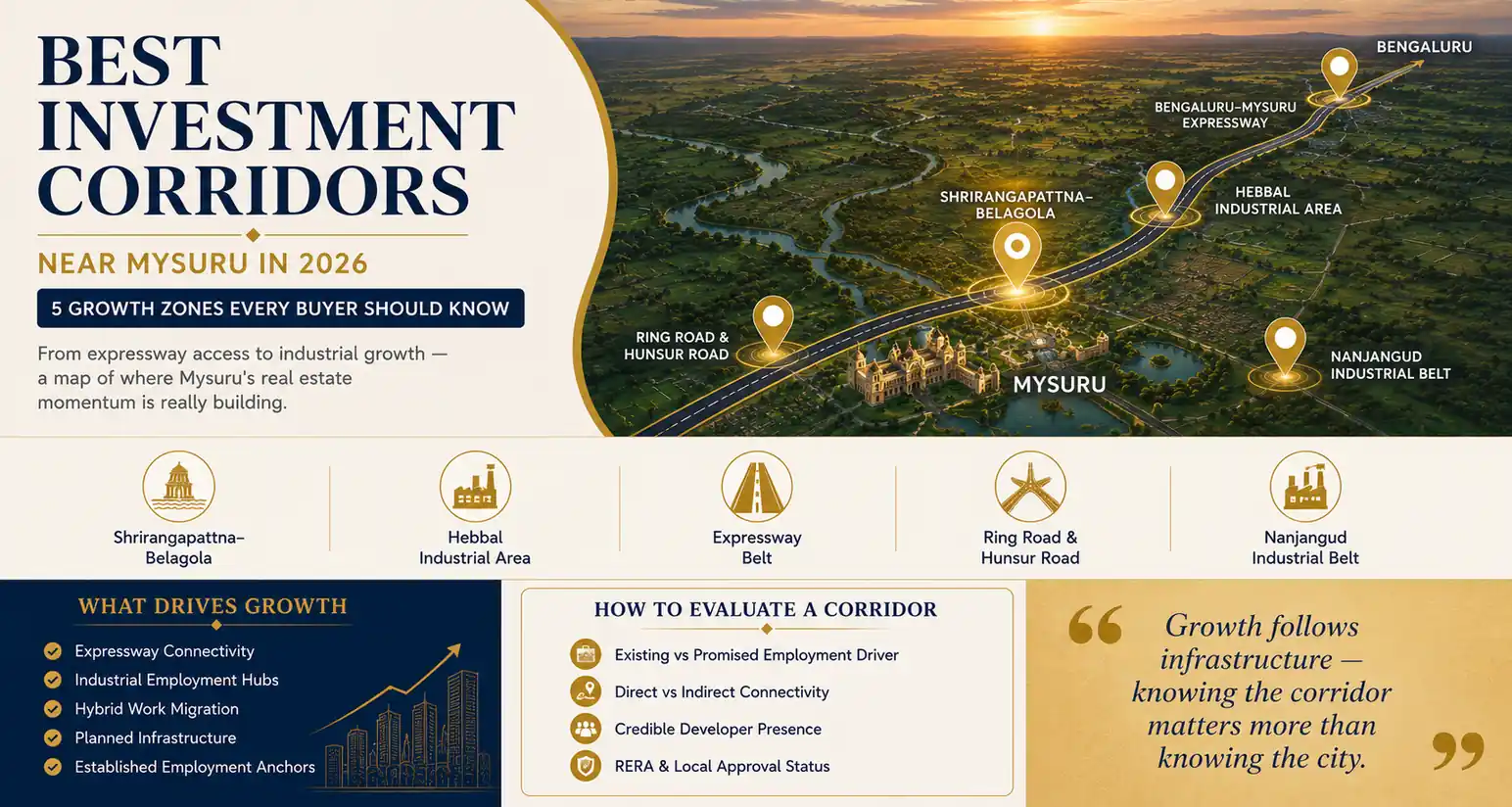
Mysuru’s Ring Road and the Hunsur Road stretch (which extends toward Coorg, Hassan, and Mangalore) serve a different kind of buyer those who want to be closer to the city centre itself rather than further out toward Bengaluru.
This corridor tends to suit end-users more than pure investors: families who want city conveniences established schools, hospitals, malls within a shorter daily commute, while still avoiding the densest parts of central Mysuru.
Appreciation here tends to be steadier and less dramatic than the expressway belt, but it also comes with lower risk, since demand is anchored in genuine end-use rather than speculative growth bets.
Nanjangud, south of Mysuru, has developed a reputation as one of Karnataka’s more established industrial zones outside Bengaluru, hosting a mix of manufacturing and pharmaceutical units over the years.
For residential investment, this corridor works on a longer time horizon. It’s less about immediate lifestyle appeal and more about the slow, compounding effect of sustained industrial employment on surrounding land values. This suits patient investors more than end-users looking for a home to move into soon.
Regardless of which corridor you’re drawn to, a few questions consistently separate a good decision from a speculative one:
Is there an existing employment driver, or just a promised one? Land near an operating industrial area or established tech park has a different risk profile than land near something still “planned” or “upcoming.”
How direct is the connectivity, really? A corridor that’s technically “near the expressway” but requires a long detour through village roads to actually reach it isn’t the same as one with a direct access point.
Who else is developing here? When credible, listed developers commit to a corridor — not just local layout promoters — it’s usually a signal that due diligence has already been done on the fundamentals: land titles, approvals, and growth trajectory.
Is the specific project RERA registered and locally approved? This matters independent of which corridor you choose. A great corridor with a poorly registered project is still a risky purchase.
If you’re weighing where to put money into Mysuru real estate this year, the honest answer is that no single corridor is universally “best” — it depends on your timeline, your risk appetite, and whether you’re buying to live or buying to hold.
That said, the Shrirangapattna–Belagola stretch is worth particular attention right now, given the combination of expressway access, proximity to an established industrial base, and the entry of credible, RERA-registered developments into the area. SOBHA Boulevard is a useful example of what a properly planned, fully approved plotted development in this corridor looks like — 126 plots, MUDA sanction, Karnataka RERA registration, and a location that benefits directly from all three growth drivers shaping Mysuru right now.
Whichever corridor you choose, the fundamentals to verify stay the same: real connectivity, a genuine employment or growth driver, and a project that’s fully compliant and transparent about its approvals.
Regardless of which way you lean, verify these before signing anything:
Is the project RERA registered, and does the registration number check out on the Karnataka RERA portal?
Is the layout approved by the relevant local authority (MUDA, BDA, or equivalent)?
What is the developer’s track record on past project delivery?
For plots specifically — is the title clear, and are basic amenities like roads, drainage, and lighting already in place?
There's no single "best" corridor — it depends on your goals. The Shrirangapattna–Belagola stretch stands out right now due to its combination of expressway access, proximity to the Hebbal Industrial Area, and the entry of credible, RERA-registered developments. But Ring Road and Hunsur Road suit end-users wanting proximity to the city centre, while Nanjangud suits patient, long-term investors.
Yes, based on current infrastructure trends. It sits directly off the Bengaluru–Mysuru Expressway and KRS Road, and is close to Mysuru's established Hebbal Industrial Area. The presence of large, RERA-approved plotted developments like SOBHA Boulevard in this corridor is also a reasonable indicator that established developers see long-term demand here.
The expressway has significantly reduced travel time between the two cities, making towns and villages along the corridor viable for hybrid workers and long-term residents, not just holiday-home buyers. This has increased demand and land values in areas with direct expressway access.
Land near an established, operating industrial area tends to have steadier and more predictable appreciation, since the demand driver — employment — already exists rather than being speculative. That said, appreciation timelines can be slower and more gradual compared to expressway-facing corridors.
This varies widely based on design complexity, approvals, and budget, but a straightforward independent home typically takes twelve to eighteen months from the start of construction to move-in, assuming approvals are in place.
Both matter, but in a different order. A strong corridor with poor project fundamentals (unclear titles, no RERA registration) is still risky. See the "How to Actually Evaluate a Corridor" section above for the specific checks worth running before you commit to either.
Waterfront Apartments in Kochi: Why Marina One Stands Out More Details Contents Ask anyone who’s house-hunted in Kochi over the
Kismatpur, Hyderabad: A Complete Locality Guide for Homebuyers and Investors Know More Contents Kismatpur is one of those Hyderabad localities
What Living at Sobha One World Actually Feels Like Know More Contents Price sheets and floor plans can give you

Under Construction vs Ready to Move: Sobha One World’s 2032 Possession Explained Know More Contents Picture two identical-looking listings for

Carpet Area vs Saleable Area: What Mumbai Homebuyers Actually Pay For Know More Contents If you’ve been flat-hunting in Mumbai
Home Loan Guide for Sobha One World Hoskote: Rates, EMI & Eligibility (2026) Know More Contents If you’re planning to
WhatsApp us
Exclusive Offers | Download Brochure | Schedule Site Visit