

Buying an Under-Construction Flat in Kerala: 7 RERA Checks
Buying an Under-Construction Flat in Kerala: 7 RERA Checks Contents Introduction Before paying for a flat that is still being
If you’ve started house-hunting near Mysuru, you’ve probably hit this fork in the road already — do you buy a plot and build later, or go with a ready (or under-construction) apartment?
It’s not a trivial decision. The two options come with different costs, different timelines, and very different long-term outcomes. Here’s an honest, no-fluff comparison to help you figure out which one actually fits your situation.
On the surface, it looks simple: a plot is land, an apartment is a finished home. But the real difference runs deeper it’s about control, timeline, and what you’re actually paying for.
When you buy an apartment, a large part of what you’re paying for is the construction cost, the amenities, and the convenience of moving in almost immediately. When you buy a plot, you’re paying almost entirely for the land itself and the value of land, unlike a building, doesn’t depreciate with age.
That single distinction is why serious long-term investors and NRI buyers so often gravitate toward plots in growth corridors.
Apartments typically come at a higher upfront cost per square foot because the price includes construction, finishing, common amenities, and the developer’s margin on the built structure. You’re also usually locked into a maintenance fee for as long as you own it.
Plots are priced almost entirely on land value and location. There’s no depreciating structure baked into the price. As an example, SOBHA Boulevard near Shrirangapattna offers plots starting from ₹79 Lakhs — and what you’re buying is 100% land in a MUDA-approved, RERA-registered layout, with the freedom to construct on your own schedule and budget.
Over a 10-15 year horizon, land in a well-located growth corridor has historically appreciated faster than the resale value of an equivalent apartment, simply because buildings age and land doesn’t.
This is where the two options genuinely serve different needs.
If you need a home in the next 12 months — say you’re relocating for work or your family needs stability quickly — a ready or nearly-ready apartment makes practical sense.
If you have some flexibility and you’re thinking long-term, a plot gives you something an apartment never will: the ability to build exactly what you want, when you want. You can start construction immediately, wait a few years while the land appreciates, or build in phases as your budget allows. That kind of flexibility simply isn’t available once you sign for a flat.
An apartment gives you four walls someone else designed. You can renovate the interior, but the floor plan, the facade, the number of rooms, the ceiling height — all of it is fixed the day you buy.
A plot puts all of that in your hands. Want a home office with a separate entrance? A larger kitchen? A rooftop terrace? You design it. This is one of the most underrated advantages of plotted developments — the home actually reflects how you live, not a generic floor plan optimised for the maximum number of units per floor.
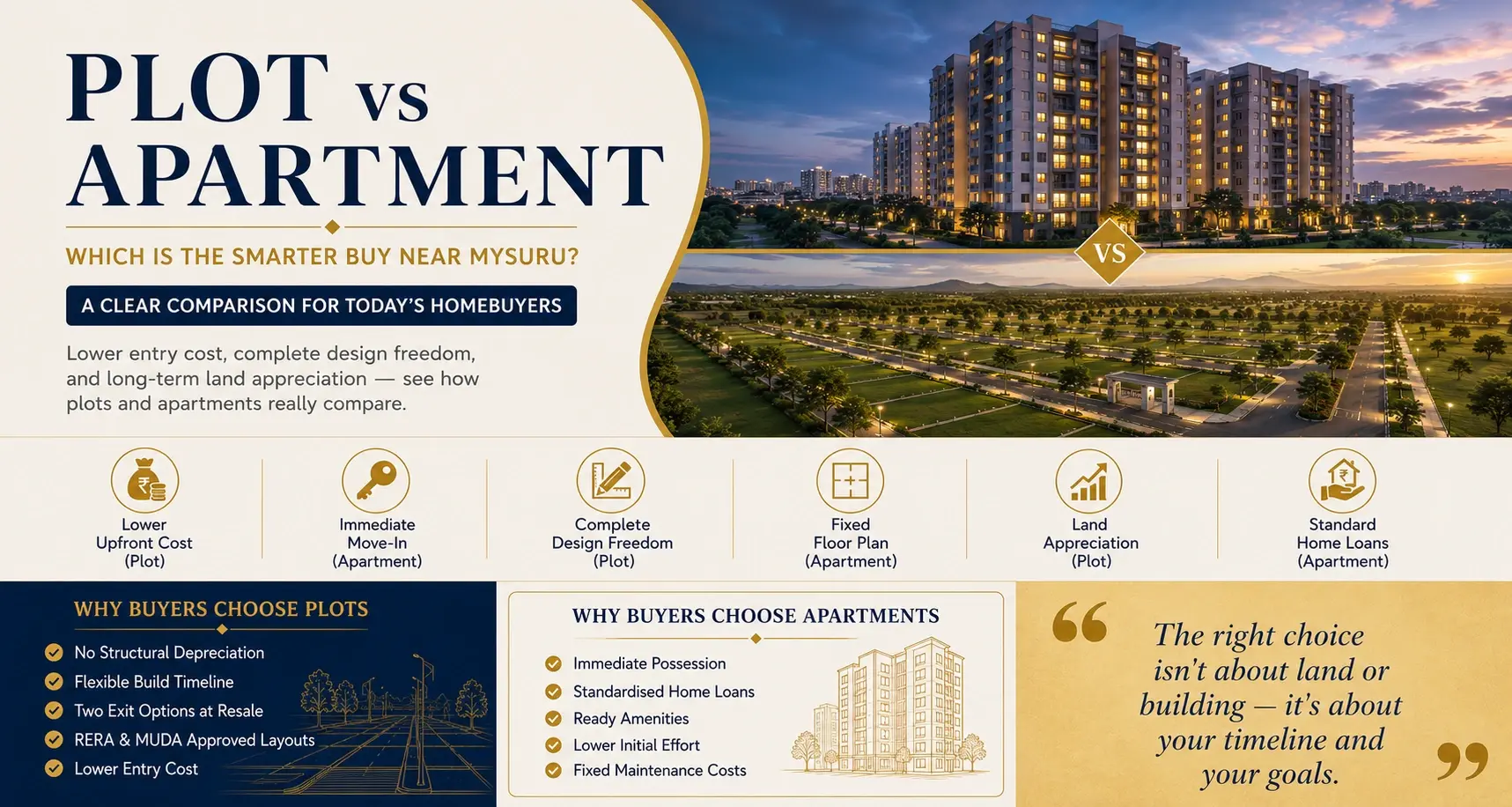
Sometimes a table does what three paragraphs can’t. Here’s how the two options stack up on the factors that genuinely influence a buying decision:
Factor | Plot | Apartment |
Upfront cost | Lower — you’re paying for land only | Higher — includes construction, finishes, amenities |
Move-in timeline | Depends on when you choose to build | Immediate or near-immediate |
Customisation | Complete control over design | Fixed floor plan, limited changes |
Maintenance cost | None until you build | Ongoing society/maintenance fees |
Depreciation risk | Land doesn’t age | Structure ages, value can soften over time |
Appreciation potential | Tied to location growth, historically stronger long-term | Tied to location + building condition |
Regulatory protection | RERA + local authority approval (MUDA, BDA, etc.) | RERA protection on construction and delivery |
Loan availability | Available, but terms differ from home loans | Standard home loan terms, easier processing |
Exit flexibility | Can sell as land or after construction | Can only sell as a built unit |
None of these rows tell the whole story on their own — but together, they paint a fairly clear picture of why plots and apartments serve fundamentally different buying goals.
One thing that surprises a lot of first-time plot buyers: financing a plot works differently from financing an apartment.
Banks typically offer a plot loan or land loan rather than a standard home loan, and the terms are often slightly different — loan-to-value ratios tend to be a bit more conservative, and some lenders require proof that you intend to construct within a set period to keep the loan classified favourably. If you’re planning to build immediately, some lenders offer a combined plot-plus-construction loan, which can simplify things considerably. If you’re planning to hold the land purely as an investment, a straightforward plot loan — or paying largely out of pocket — is more common.
Apartment loans, by contrast, are far more standardised. Nearly every major lender offers home loans against ready or under-construction apartments with familiar terms, faster processing, and often higher loan-to-value ratios.
Neither option is difficult to finance. But it’s worth having this conversation with your bank before you commit to either path, because the loan structure can meaningfully affect your overall cash flow.
Exit strategy is something buyers rarely think about at the time of purchase — and then think about constantly a decade later.
With an apartment, your resale value is capped by the age and condition of the building, regardless of how good the location is. Buyers factor in the building’s remaining life, the upkeep of common areas, and how dated the amenities feel compared to newer projects nearby.
With a plot, you have two exit paths. You can sell the land as-is, which tends to track the appreciation of the surrounding area fairly closely. Or you can build a home and sell it as a finished property, which usually commands a premium over raw land, assuming the construction quality holds up.
This flexibility is a quiet but significant advantage of land ownership. You’re not locked into a single way of realising your investment.
This is the question every serious buyer eventually asks, and the honest answer is: it depends on location, but land generally has the edge.
An apartment’s value is tied to the building’s condition, its age, the society’s upkeep, and how well the amenities have aged. A 15-year-old apartment building, even in a good location, often sells at a discount compared to a newer one nearby.
Land doesn’t have that problem. A plot in a location with strong infrastructure fundamentals — highway connectivity, industrial growth, proximity to employment hubs — tends to appreciate independent of any structure sitting on it. This is precisely why the corridor connecting Mysuru to Bengaluru via the expressway has become such a closely watched investment zone. Growth in areas like Shrirangapattna is being driven by the same forces that have historically driven land appreciation in outer Bengaluru over the last two decades — industrial expansion, highway access, and rising employment density.
Both options come with risk if you’re not careful, but the safeguards look different.
For apartments, RERA protects you against construction delays and misrepresented specifications. For plots, RERA registration protects you against unclear land titles, unapproved layouts, and missing infrastructure commitments — arguably a bigger risk category in the plotted development space, where unregistered or unapproved projects are unfortunately common.
This is why developer credibility matters so much more with land purchases. A RERA-registered, MUDA-approved project from an established developer — the kind of project SOBHA Boulevard represents — removes most of the uncertainty that makes plot buying feel risky to first-timers.
Here’s a simple way to think about it:
Choose an apartment if you need to move in within the next year, you want zero involvement in construction, or you’re prioritising immediate convenience over long-term customisation.
Choose a plot if you’re building for the long term, you want control over your home’s design, you’re comfortable with a build timeline of a few years, or you’re primarily looking at this as an appreciating asset rather than an immediate residence.
For a growing number of buyers near Mysuru — especially those balancing life between Bengaluru and Mysuru thanks to the expressway — plots are increasingly winning out. The combination of lower entry cost, design freedom, and stronger long-term appreciation potential is hard to ignore, provided the project is backed by a credible, RERA-registered developer.
Regardless of which way you lean, verify these before signing anything:
Is the project RERA registered, and does the registration number check out on the Karnataka RERA portal?
Is the layout approved by the relevant local authority (MUDA, BDA, or equivalent)?
What is the developer’s track record on past project delivery?
For plots specifically — is the title clear, and are basic amenities like roads, drainage, and lighting already in place?
Generally, a plot has a lower upfront cost since you're paying for land alone, without construction or amenities baked in. The total cost evens out once you factor in building your own home, but you get to control that spend and its timing — something an apartment purchase doesn't allow.
Yes, most banks offer plot or land loans, though the terms differ slightly from standard home loans. If you plan to construct soon after purchase, ask about combined plot-plus-construction loan options, which many lenders offer.
In well-located growth corridors, land has historically appreciated faster over the long term because it isn't subject to structural depreciation the way buildings are. That said, appreciation always depends on location fundamentals — infrastructure, connectivity, and demand — regardless of whether it's a plot or an apartment.
It can be, if the project isn't RERA-registered or locally approved. That's why verifying RERA registration and authority approval (like MUDA in Karnataka) is non-negotiable before buying land. With a credible, registered developer, the risk profile is comparable to buying an apartment.
This varies widely based on design complexity, approvals, and budget, but a straightforward independent home typically takes twelve to eighteen months from the start of construction to move-in, assuming approvals are in place.
Probably not. Plots suit buyers with some flexibility on timeline. If you need a home within the next year, a ready or near-ready apartment is the more practical choice.
As per the RERA registration, the proposed completion date is December 31, 2028. The project start date is July 1, 2026.
There’s no universally “right” answer between a plot and an apartment — it depends on your timeline, your appetite for involvement in construction, and how you’re weighing convenience against long-term value.
But if long-term ownership, design freedom, and land appreciation are what you’re after, a well-planned, RERA-registered plotted development is hard to beat. SOBHA Boulevard in Shrirangapattna is a good example of what that looks like done right — a credible developer, full regulatory approval, and a location with genuine growth momentum behind it.
Buying an Under-Construction Flat in Kerala: 7 RERA Checks Contents Introduction Before paying for a flat that is still being
Living in Feroke, Kozhikode: What Buyers Should Know Contents Introduction Feroke is a municipality in the Kozhikode metropolitan area, about

What Is an EOI in Real Estate? A Bangalore Buyer’s Guide to Pre-Launch Registration Know More Contents If you’ve been
Sobha One World Payment Plan and RERA: A Buyer’s Guide Know More Contents Bangalore’s growth has never really moved in
Sobha One World Payment Plan and RERA: A Buyer’s Guide Know More Contents Buying a home in a project that
Sobha One World Floor Plans: Which BHK Fits You? Know More Contents Most floor plan pages list the same
WhatsApp us
Exclusive Offers | Download Brochure | Schedule Site Visit