Why This Confusion Exists in the First Place
Before 2016, Indian developers could advertise a flat’s size using almost any measurement that made it look bigger built-up area, super built-up area, or a “loading” percentage that quietly added common corridors, lift lobbies, and even the width of your own walls into the number you were quoted. Two flats with identical usable space could be advertised at very different sizes depending on which developer’s marketing team wrote the brochure.
The Real Estate (Regulation and Development) Act, 2016 (RERA), was written partly to fix exactly this. It legally defines carpet area and requires every RERA-registered project to state it, which is why you’ll now see “RERA Carpet Area” as a specific line item on any legitimate cost sheet in Maharashtra.
The Three Numbers You’ll See on Any Cost Sheet
The carpet area is the actual usable floor space inside your apartment’s walls, literally the area you could cover with a carpet. It excludes the thickness of your own walls, balconies (usually), and anything outside your front door. This is the number RERA legally defines and requires developers to disclose, and it’s the only one that tells you what you’re actually paying to live in.
Built-up area (sometimes called “ancillary area” on modern cost sheets) adds the thickness of your walls and, depending on the project, balcony space. It’s larger than carpet area but still specific to your unit; it’s not shared with anyone else in the building.
Saleable area (also called super built-up area) is the number that includes your built-up area plus a proportional share of common spaces, lobbies, stairwells, the clubhouse, and sometimes even the swimming pool. This is usually the biggest number on the sheet, and historically, it’s the one most heavily used in marketing because a bigger number sounds better in a headline.
Here’s a simple way to keep the three straight:
Term | What it includes | What it’s used for |
Carpet area | Usable floor space inside your walls | The legally mandated, RERA-defined figure |
Built-up/ancillary area | Carpet area + your own wall thickness + balcony | A more complete picture of your private space |
Saleable area | Built-up area + a share of common areas | What many price-per-sq.ft. comparisons are based on |
Why the Gap Between These Numbers Matters More Than You Think
The difference between carpet area and saleable area is sometimes called the “loading,” and it isn’t fixed. It varies by developer, by building design, and even by which floor or wing a specific unit sits in, because units with more shared amenities nearby (like a clubhouse-facing wing) sometimes carry a slightly higher loading than a plainer wing in the same tower.
This matters for one very practical reason: if you’re comparing price per square foot across two projects, you need to know which area each number is based on. A flat quoted at “₹25,000 per sq.ft.” on saleable area could work out to a meaningfully higher effective rate per sq.ft. of carpet area than a flat quoted at “₹28,000 per sq.ft.” on carpet area directly. The sticker price tells you very little until you know the denominator.
A quick worked example: a 3 BHK might be advertised as 1,225 sq. ft. (saleable), but the RERA carpet area the space you actually live in could be closer to 1,130 sq. ft. That’s roughly an 8% gap, which is fairly typical for a well-designed high-rise, but it’s worth confirming for every project you’re comparing, because the gap isn’t standard across the industry.
What to Actually Ask For Before You Book
- The RERA carpet area figure specifically, not just “the area” ask the sales team to point to the exact line on the RERA-approved plan.
- The saleable-to-carpet ratio for the specific unit you’re considering, not just a project-wide average, corner units, higher floors, and amenity-adjacent units can carry different loading.
- Whether the price quoted is per sq.ft. of carpet area or saleable area, this single question resolves most cross-project price confusion instantly.
- The project’s MahaRERA registration number, so you can independently verify the carpet area figure against the official filing on the MahaRERA portal rather than relying solely on the brochure.
A Real Cost Sheet, As a Worked Example
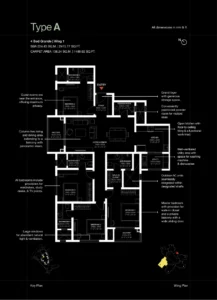
It’s easier to see this in practice than in the abstract. SOBHA Inizio in Parel, Mumbai, lays out carpet area and saleable area separately for each configuration for instance, its 3 Bed Residence Luxe is listed at 944.76 sq.ft. RERA carpet area against 1,021.29 sq. ft. saleable area, a gap of roughly 8%. Looking at a real, RERA-disclosed cost sheet like this is a genuinely useful exercise before you go comparing brochures across builders, because it shows you exactly which line to check first, regardless of which project you eventually choose.
FAQ
Is carpet area or saleable area the “real” size of my flat?
Carpet area is the number that reflects your actual usable, walkable floor space. The saleable area includes a share of the building’s common areas and will always be a larger number for the same unit.
Why do builders quote saleable area instead of just carpet area?
Historically, saleable area produces a bigger, more marketable number, and price-per-sq.ft. comparisons across the industry have often been based on it. RERA doesn’t ban quoting the saleable area; it just requires the carpet area to be disclosed as well, so buyers have both figures to compare.
Does RERA require carpet area to be disclosed?
Yes. RERA legally defines carpet area and requires it to be stated for any RERA-registered project, which is why “RERA Carpet Area” appears as a specific line item on compliant cost sheets.
What’s a “normal” gap between carpet area and saleable area?
It varies by project and building design; there’s no fixed industry standard, but a gap in the 15–25% range between saleable area and carpet area is common in mid- to high-rise developments with substantial shared amenities. Always check the actual figures for the specific project rather than assuming a percentage.
Can I verify a project’s carpet area myself?
Yes every RERA-registered project’s approved plans, including carpet area figures, are available on the state’s RERA portal (in Maharashtra, that’s MahaRERA) under the project’s registration number.